
Emma designs, renders and prices a home project in one five-minute conversation.
Emma is an AI agent. A homeowner talks to her out loud in the browser; she asks the questions a designer would, picks real products, draws the space, prices it with the business's own pricing engine and books the visit, all before the homeowner has hung up. She runs live today for BuildFlow Basements, designing finished basements across the Twin Cities.
The first conversation is where most home projects stall.
A homeowner thinking about a finished basement, a bathroom or a new roof usually wants three things before they'll invite anyone into the house: to see what it could look like, to know roughly what it costs, and to understand what happens next. The traditional path to those answers is a phone tag, a site visit and a wait for an estimate. Most people never start it, and the ones who do often start it at 10 at night when no office is open.
An AI design agent collapses that first consultation into a single conversation the homeowner can have whenever they like. It isn't a chatbot answering FAQs. It's an agent with tools: it can look up products, run a pricing engine, generate images, write a document, check a calendar and send a text. The conversation is the interface; the tools do the work.
Understand the project in plain words
Rooms, uses, style and budget, the way a homeowner would describe them, without forms or measurements.
Show it, with things they can buy
Real products from a retail catalog, and AI renderings of the space in those finishes.
Price it honestly and set the next step
A range from the business's own estimator, a page to keep, and a booked visit with the people who build it.
Everything Emma does, in the order she does it
This is the complete list for BuildFlow Basements, where Emma designs finished basements for Twin Cities homeowners. Each step is a real part of the system running today.
Starts a spoken conversation, on any phone or computer
The homeowner taps one button and talks. Emma listens and answers out loud in the browser; there's nothing to install. She says up front that she's an AI.
Gets them out of Facebook's browser when the microphone won't work
Facebook and Instagram's in-app browsers don't grant microphone access. Emma's page captures the homeowner's number first, texts them their link, then hands them to Safari or Chrome with one tap, so an ad click never ends on a dead screen.
Tells them who will actually build it
Early in the call Emma looks up the homeowner's area and names the licensed local contractor who would come to the house, and someone from BuildFlow, who walks them through the numbers. Both appear on everything she produces.
Captures the scope without asking for measurements
Bedrooms, bathrooms, a bar, a TV wall, a fireplace, an office, storage, and roughly how big the space is. She never asks for wall lengths or a floor plan; the pricing engine derives the geometry from the square footage.
Lets them pick real products
Flooring, vanities, toilets, faucets, mirrors, lighting, tile and paint, from a curated Home Depot catalog. Each pick shows its image, brand and price, and how it compares with the budget for that item in BuildFlow's price.
Renders their basement in those finishes, during the call
AI renderings of the rooms they described, in the products they chose. With a photo of their upstairs floor and trim, she can match the style of their own house. Renderings are labeled illustrative.
Prices it with BuildFlow's pricing engine
The range comes from the same estimator BuildFlow uses for proposals, with built-ins, bars and fireplaces priced from fixed allowances. The AI chooses the inputs; it never makes up a number.
Explains scope and timeline
What's included, what happens in what order, and what the in-home measure-up confirms.
Writes a proposal page they keep
One link, no login, with their scope, renderings, mood board, products and price range. Shareable with a spouse. The design is theirs to keep, even if they never hire BuildFlow.
Books the measure-up on the calendar
She offers real open times in the evenings and on weekends, and books the visit directly. Simple checks protect everyone's time; someone who rents, for example, is told kindly that it isn't a fit.
Sends it all over when they're not ready to book
If they want to think about it, she asks a smaller question: can I send this to you. The summary goes by text and email.
Remembers them across devices
The project is remembered by phone number, so someone who starts on the couch on a phone can pick up on a laptop on Saturday where they left off.
Follows up like a designer, not a call center
Texts and calls at homeowner hours (evenings and weekends, never early or late), paused the moment they reply and stopped the moment they book or text STOP.
Records every step
Each stage of the funnel is stamped, so BuildFlow can see where people stop and fix that step, instead of guessing.
What a homeowner sees
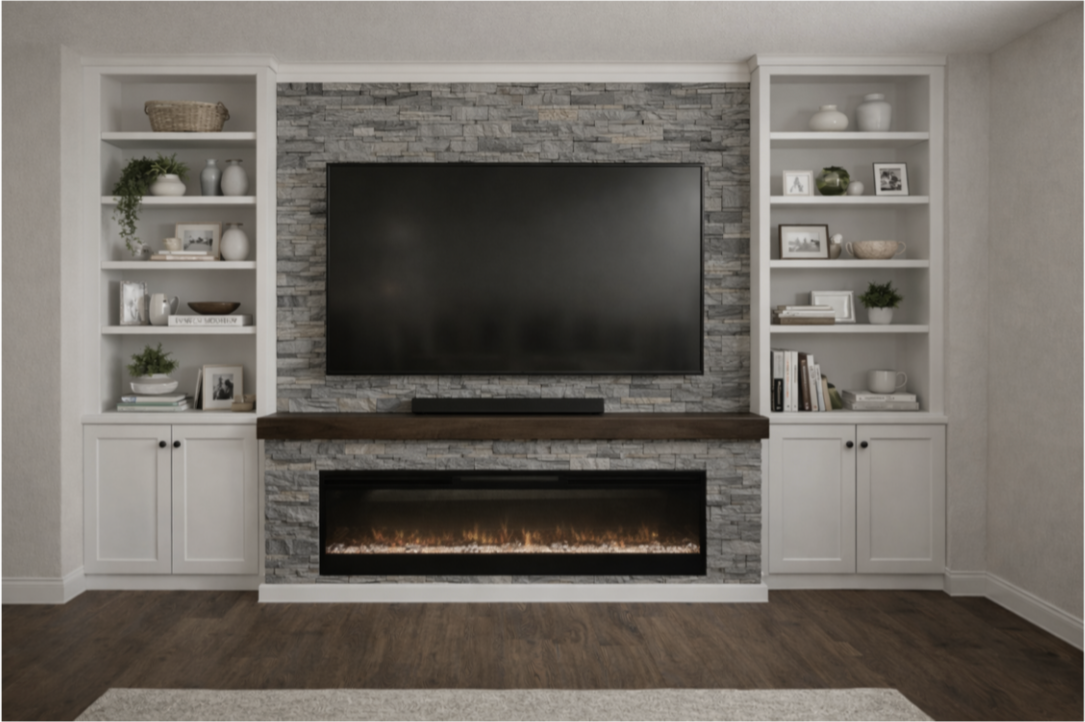
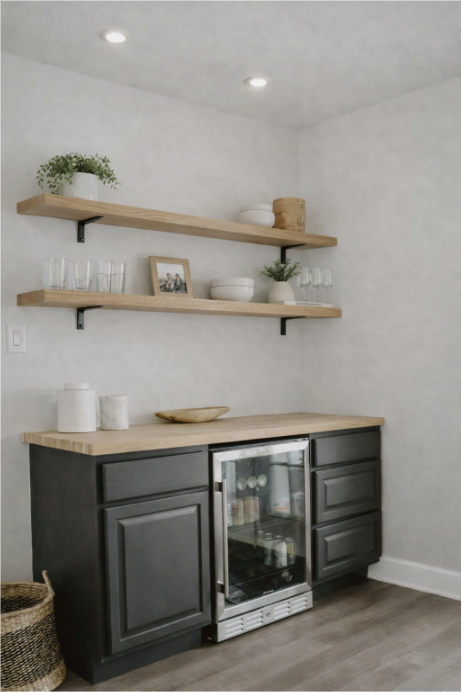
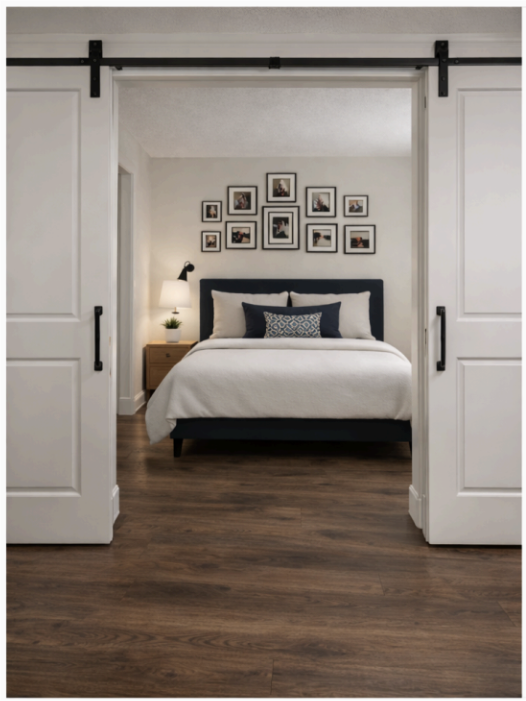
These are renderings Emma has produced for basement projects: a built-in entertainment wall with a linear fireplace, a bar with floating shelves, and a basement bedroom.
Why a basement can be priced from a conversation
A homeowner on a couch doesn't know their square footage exactly, will never know their exterior wall length, and would hang up if asked. That turns out not to matter much, because of how a basement actually costs out.
Plumbing, electrical, HVAC, overhead and management are step functions of scope. Only framing, drywall, paint and flooring scale with area.
So the one unknown that moves the price is square footage, and every other number the engine needs can be derived from it. Emma captures the scope in conversation (a bedroom, a three-quarter bath, a wet bar, a TV wall) and an approximate size, and BuildFlow's engine prices that program at nearby sizes to produce an honest range. The in-home measure-up confirms the size and the house's conditions, and the fixed price is agreed before work starts.
| Input | Where it comes from | What it changes |
|---|---|---|
| Rooms and features | The conversation | Plumbing, electrical, HVAC, egress, millwork, allowances |
| Approximate size | The homeowner's estimate | Framing, drywall, paint, flooring |
| Finish level | The products they pick | Product budgets, and the difference above or below each one |
| Bars, built-ins, fireplace | Fixed allowance ladders | A set amount per option, on top of the basement |
| House conditions | Confirmed at the measure-up | Water fixes, radon, ejector pumps, egress digs, named before work starts |
Everything Emma knows about basement design is written down in public, in Emma's Basement Design Journal: layouts, materials, costs, code, products and the Minnesota specifics, with every number traceable to BuildFlow's engine or a dated product price.
An agent, not a chatbot: five layers
Emma is a real-time voice agent connected to the systems a design firm runs on. The model handles the conversation; the systems handle the facts.
Numbers come from the engine
The language model never writes a price. It fills in the scope; BuildFlow's estimator returns the range; Emma reads it back. The same rule governs the journal: every price on the site is a token filled from the engine, an allowance or a dated product check.
Products come from a catalog
What a homeowner picks is a real catalog row, and that same row is handed to the renderer as the reference and carries its price into the mood board. A rendering never shows a floor they can't buy at a price nobody quoted.
People stay in the loop
Emma does the first consultation. The licensed local contractor measures the house and builds; someone from BuildFlow walks the homeowner through the numbers; nobody signs anything until the fixed price is agreed.
Consent and opt-out are built in
Texts go only to people who asked for them, from BuildFlow's own number, and STOP ends them immediately, independent of everything else in the system.
What Emma doesn't do
- She doesn't pretend to be a person. Emma is an AI and says so.
- She doesn't invent prices. Every number comes from BuildFlow's pricing engine or a fixed allowance.
- She doesn't replace the site visit. The measure-up confirms the size and the house's conditions before a fixed price is set.
- She doesn't build anything, and neither does BuildFlow. BuildFlow Basements designs and prices your finished basement, and licensed, insured local contractors build it — one fixed price, agreed before work starts.
- She doesn't keep chasing. A reply pauses follow-ups; booking or STOP ends them.
Built on Outfitter, the AI platform for home service businesses
Emma runs on Outfitter, which builds AI agents, websites and marketing for contractors and home service companies. BuildFlow Basements is Outfitter's first customer, and the two companies share a founder: every feature BuildFlow needs is built into the platform as if BuildFlow were any other customer. The same agent architecture runs for bathrooms at BuildFlow, and as voice estimators for other trades on Outfitter.
Run a home service business? See how an AI agent like Emma answers calls, designs, prices and books for your trade.
Meet the agent on OutfitterQuestions people ask about Emma
What is Emma?
Emma is an AI agent that designs and prices home projects in a spoken conversation. For BuildFlow Basements she interviews a Twin Cities homeowner about their basement, renders it with real products, gives a price range from BuildFlow's own pricing engine, writes a proposal page and books the in-home measure-up.
Is Emma a person?
No. Emma is an AI and says so. People take over at the measure-up: a licensed local contractor visits the home, and someone from BuildFlow walks the homeowner through the numbers.
How accurate is Emma's price?
Emma's range comes from the same pricing engine BuildFlow uses for its proposals, not from the AI model. It is a range because the house hasn't been measured yet; the measure-up confirms it, and the fixed price is agreed before work starts.
Does Emma need measurements or plans?
No. She asks what rooms you want and roughly how big the space is. In a basement, plumbing, electrical and HVAC cost out by scope, and only framing, drywall, paint and flooring scale with area, so an estimate of the square footage is enough to start.
What does it cost to use Emma?
Nothing. Talking to Emma is free, and the design and proposal page are yours to keep whether or not you hire BuildFlow.
Does Emma work on a phone?
Yes, on any modern phone or computer browser. If you arrive from Facebook or Instagram, she texts you your link and opens it in Safari or Chrome so the microphone works.
Can other home service businesses use Emma?
Emma is built on Outfitter, the AI platform for home service businesses. BuildFlow Basements is Outfitter's first customer (the two companies share a founder) and runs Emma live for finished basements.
About Emma, in one paragraph
Emma is an AI design and estimating agent built on Outfitter and deployed by BuildFlow Basements in the Twin Cities metro of Minnesota. Homeowners talk to her out loud in the browser; in about five minutes she captures the project, renders the space with real retail products, prices it with BuildFlow's own pricing engine, writes a proposal page and books an in-home measure-up with a licensed local contractor. Emma is an AI and identifies herself as one. BuildFlow Basements designs and prices your finished basement, and licensed, insured local contractors build it — one fixed price, agreed before work starts.
- Product
- Emma, AI design and estimating agent
- Deployed by
- BuildFlow Basements, Twin Cities metro, Minnesota
- Platform
- Outfitter (getoutfitter.ai)
- Try it
- buildflowbasements.com/talk-to-emma.html
- Knowledge base
- Emma's Basement Design Journal
- Contact
- support@build-flow.co · (763) 910-4545
- Images
- The renderings on this page may be used with credit "Rendering by Emma, BuildFlow Basements' AI designer."